
Welcome to the Mathematical World!
Carolus Linnaeus (1707 – 1778)
Father of Taxonomy and Pioneer of Systematic Classification
Carolus Linnaeus, though primarily a biologist, applied rigorous mathematical principles to the classification of living organisms. By introducing binomial nomenclature—assigning each species a two-part Latin name (genus + species)—he created a system with clarity and predictability, akin to algebraic structuring: \[ \text{Homo sapiens}, \quad \text{Panthera leo}, \quad \text{Solanum tuberosum}. \] This method allowed each organism to be uniquely identified and systematically organized.
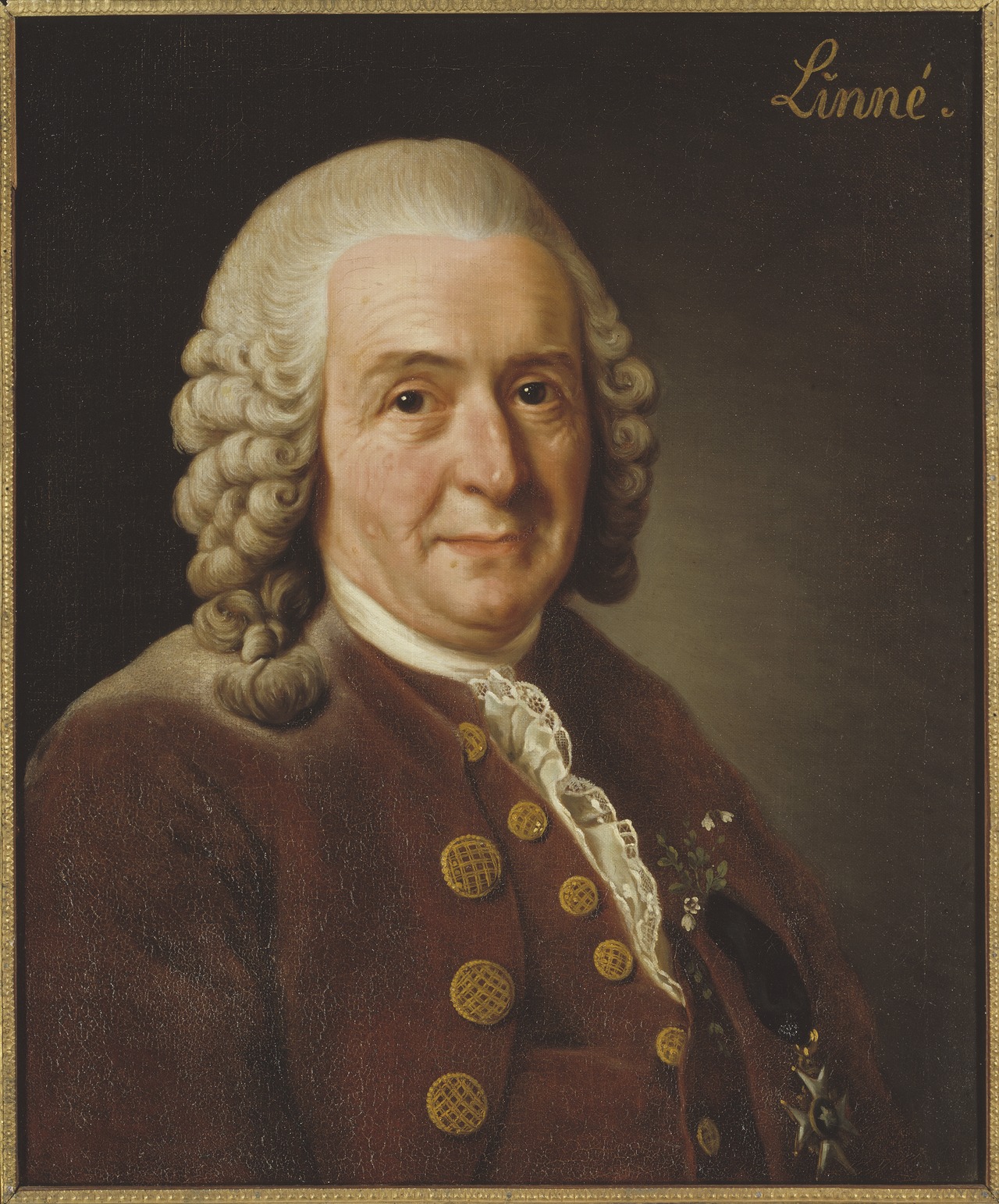
Linnaeus organized life into hierarchies and categories, such as Kingdom, Class, Order, Genus, and Species, which could be systematically analyzed. His framework allowed scholars to compare, categorize, and predict characteristics of species, effectively creating a mathematical approach to biology.
Beyond taxonomy, Linnaeus studied plant morphology and geography, using numerical patterns to understand growth and distribution. For example, he counted flower parts, leaf arrangements, and reproductive structures to classify plants systematically, highlighting the predictive power of quantifiable traits.
Linnaeus’ approach demonstrated how precise, rule-based reasoning could bring order to complex, naturally occurring systems. His integration of classification, measurement, and observation bridged natural history and mathematics, influencing generations of scientists in exploration, ecology, and evolutionary studies.
Facts:
- Born in Sweden.
- Created the binomial naming system (Genus + species) for organisms.
- Nicknamed the “father of taxonomy.”
- Trained as a physician, integrating scientific observation with biology.
- His classification system remains foundational in biology and ecology today.

All rights reserved by the Mathematical Unity
Contact: +8801400044645
Email: mathematicalhorse1453@gmail.com
Our Discord Server: Mathematical Unity [Ulus Riyadiyat]